

how to use what’s delivered
What arrives at your job site is designed to be installed — not sorted, stressed over, or set aside. Because Synergy Wood products are made from real wood, natural variation in grain, knots, color, and movement should be expected and celebrated. Every order is carefully manufactured, inspected, packaged, and delivered with installation in mind, but wood is a natural material and occasional imperfections or transit-related issues can occur. The good news? Nearly every board can still be used. This guide will walk you through what to expect, how to handle common situations, and the best way to maximize material yield while achieving a beautiful finished installation.
manufacturing PRECISION
When we run our tongue and groove products, our precision molder is set-up to run a product specific face width with a tolerance of ± .010″. However, because the wood being run through our molder varies due to grain and knot structure, moisture content, side bend, etc., the tolerance we accept is ± 1/16″ in width. Southern Pine has a face width of 5″ + tongue and Red Grandis has a face width of 4 3/4″ + tongue. Lengths are 5′, 6′ , 7′, 8′, 10′, 12′ and 14′. E-Peck boards and all trim molding are 10′ only. Most delivered wood ceiling boards will be varying lengths to assist in creating the desired random pattern installation.
product labels
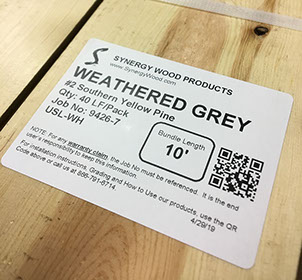
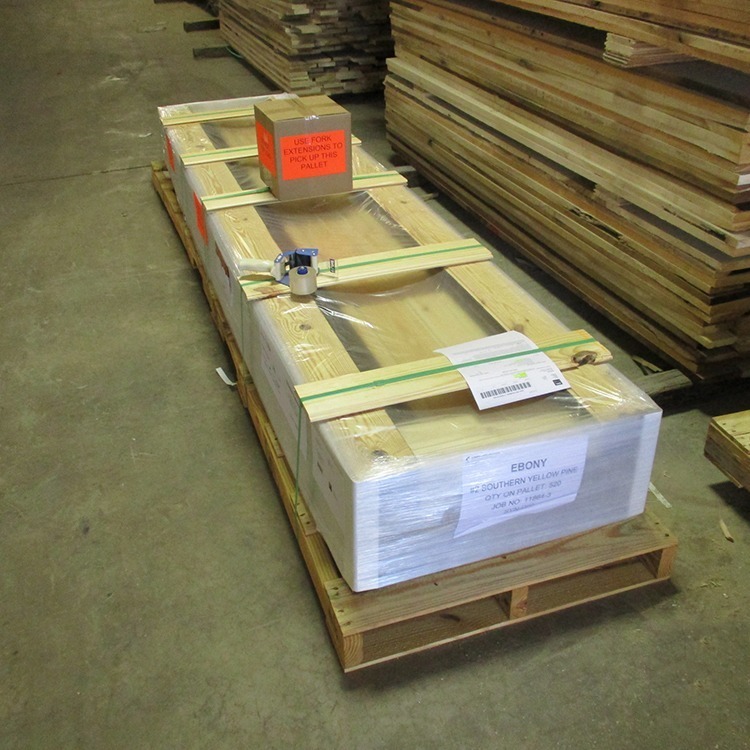
Once the Synergy product is bundled or ready to be boxed, a special label is affixed to the boards. This label identifies the product, color, wood species, job lot, and a special QR code with a link to the instruction manual (included on every bundle). When you receive your package, make sure the species, stain and pattern match your order before you start installing. Review and follow the installation manual and warranty document before installation. Feel free to call us with any installation or product questions at 866-791-6714.
Synergy Wood product labels with QR tag for installation instructions.

How To Use What is Delivered
Every Synergy Wood t&g board is carefully inspected and packaged with installation in mind. Because we work with real wood and real-world freight conditions, occasional natural characteristics, handling marks, or transit-related issues may still occur. The good news? In most cases, these boards are still fully usable and can be incorporated into a beautiful finished installation.
When installing Synergy tongue & groove products, remember that your boards are end matched, meaning end joints can fall virtually anywhere in the ceiling or wall layout. Just like a hardwood floor installation, each run will naturally require shorter cut pieces at the beginning or end.
Rather than setting aside boards with natural variation or minor undesirable characteristics, use them strategically during installation. By trimming around a knot hole, side bend, or affected area, these boards can often become ideal starting or ending pieces with very little impact on total material yield.
Two of the most common questions we receive involve knot holes and side-bent boards. Let’s take a closer look at each.
Knot Holes:
Imagine your project includes 530 lineal feet (approximately 221 sq ft) of #2 Southern Pine V-Joint, using 10′ boards (120″).
During installation, one board has a 2″ knot hole where a knot falls out. If you cut around the defect and use both remaining pieces, you have only removed 2 inches from a 120-inch board — about 1.67% of that individual board.
More importantly, in the context of the full order, that 2″ cut represents only 0.17% of the total material purchased (2″ out of 6,360 total inches of material).
Even in the unlikely scenario where 10 boards each had a 2″ knot hole, the total material loss would still be only 1.67% of the entire job — well below our recommended 5% waste allowance.
Installation Tip:
Use boards with minor defects throughout the installation rather than setting them aside for the end. Saving ten “imperfect” boards until the finish stage can create unnecessary challenges and reduce flexibility when fitting final rows or finishing transitions.
Note for E-Peck® Products: Similar to #2 grade boards, E-Peck® will have unlimited surface checks and knot holes included. Lose knots or knot holes may have tape backing. In some applications, if the knot holes are undesirable, the installer can cut these areas out and create starting or ending boards.
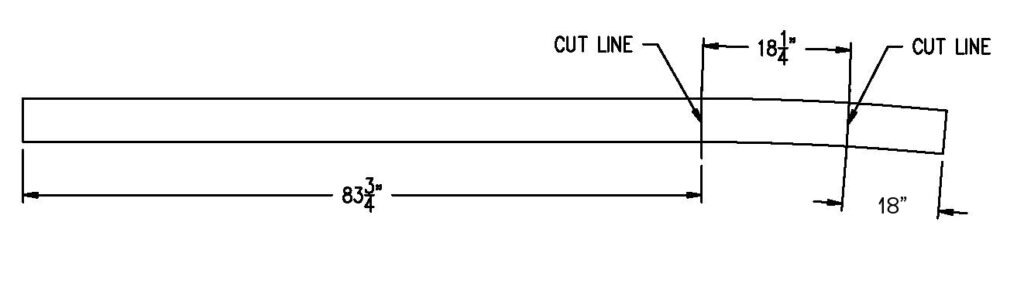
Side Bend (at end of board) Example: Using the same example above — 530 lineal feet of Southern Pine V-Joint with 10′ boards (120″) — you may occasionally encounter a board with a side bend near the end.
If one board has a bow extending approximately 84″ from one end and you trim out 18¼” of the affected section, you are removing about 15.2% of that individual board.
In the context of the full order, however, that cut represents only 0.29% of the total material purchased (18.25″ out of 6,360 total inches of material).
Side Bend (in middle of board): Let’s say that you have a 10′ board that has more than 1/2″ side bend to it, say 3/4″, as shown in the diagram below.
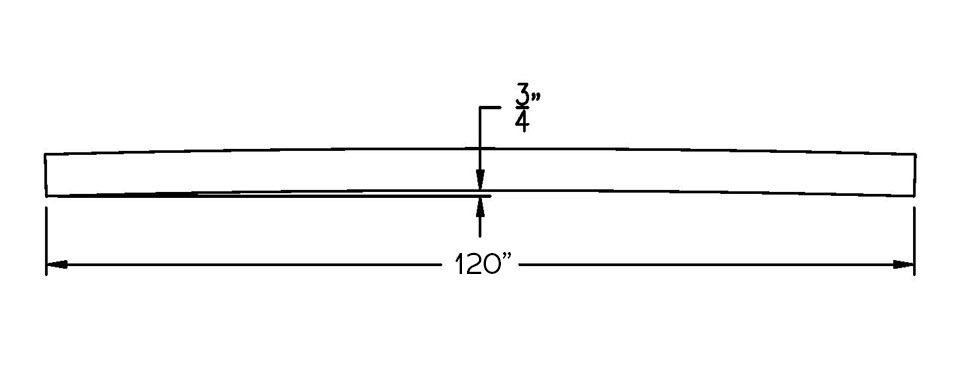
Side Bend – Cutting the board in half: Just by cutting the board in half, the side bend will go well below 1/2 the original side bend, as shown in the following diagram. Both of the remaining pieces can be used as starter or ending pieces in your ceiling.
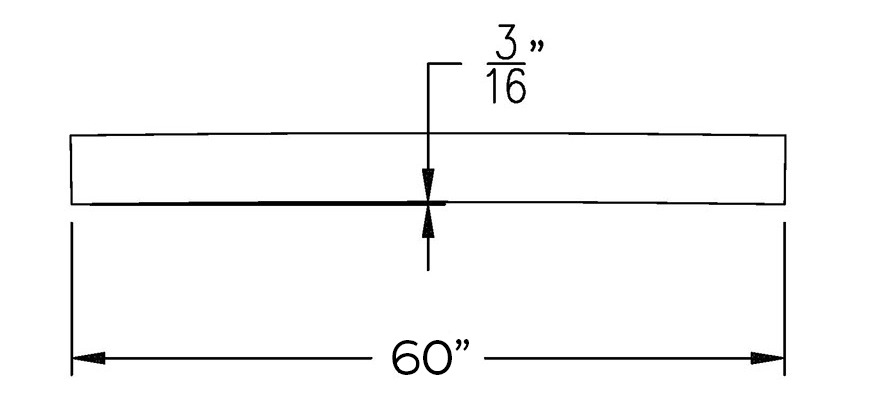
Side Bend – Cutting the board in half will give you two usable “straightened” pieces.
Installation Tip:
When a side bend occurs near the end of a board, trim the affected portion and continue installation using the remaining material. While the cut may seem significant on a single board, its impact on the total job is minimal and remains well within a typical recommended waste allowance.
Freight Delivery Information
All Synergy Wood products are carefully packaged for durability and protection during transit. If your order ships via freight, please ensure your quote accurately reflects the delivery type (residential, commercial, or job site) and whether additional delivery services are needed.
Freight deliveries are different from standard parcel deliveries. The carrier will deliver the pallet to the truck’s unloading point and does not move material into a home, garage, or building (unless arranged in advance). It is the customer’s responsibility to:
- Unload material from back of truck
- Remove the pallet and packaging from back of the truck
- Have someone available at the appointed time. The carrier will call with this information.
- No other services are provided which include, but not limited to, having the driver help in any way, liftgate service, etc. without first making those prior arrangements with Synergy Wood Products.
- If additional services are used and not authorized by Synergy Wood, the customer will be responsible for all additional charges and will be due upon receipt of invoice.
Feel free to call us with any shipping or product questions at 866-791-6714.
wood movement
Installed wood is constantly expanding and contracting due to temperature and relative humidity, wood does not move equally in all directions. The grain structure causes it to move differently in three different directions.
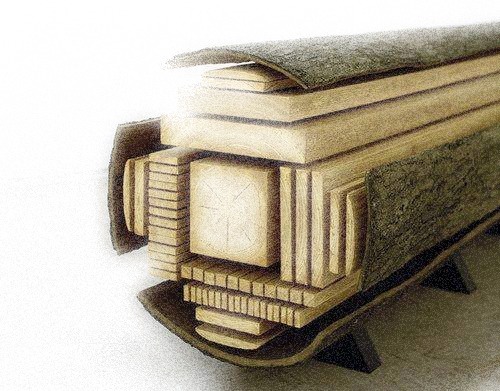
Wood is very stable along its longitudinal direction (length of board), parallel to the grain. Green lumber shrinks approximately .01% of its length as it dries.
Wood moves much more across the grain, tangent (width as it is plain-sawn) to the growth rings. Green lumber shrinks as much as 8% in this direction.
Wood moves only half as much (4%) in the radial direction (thickness as it is plain-sawn).
All wood brought into Synergy is kiln dried. Each species is slightly different and therefore will have a different moisture content. What is important is that we will not finish any wood that is above 18% moisture content.
Synergy wood acclimation
If any Synergy product is to be installed on an interior ceiling or wall, you should allow the wood to acclimate to its environment at least 72 hours (or more if possible) so that the wood equalizes.
If the product is going to be installed on an exterior porch ceiling (please read installation guides for interior/exterior applications), no acclimation period will be required; unless it is going into a very dry climate